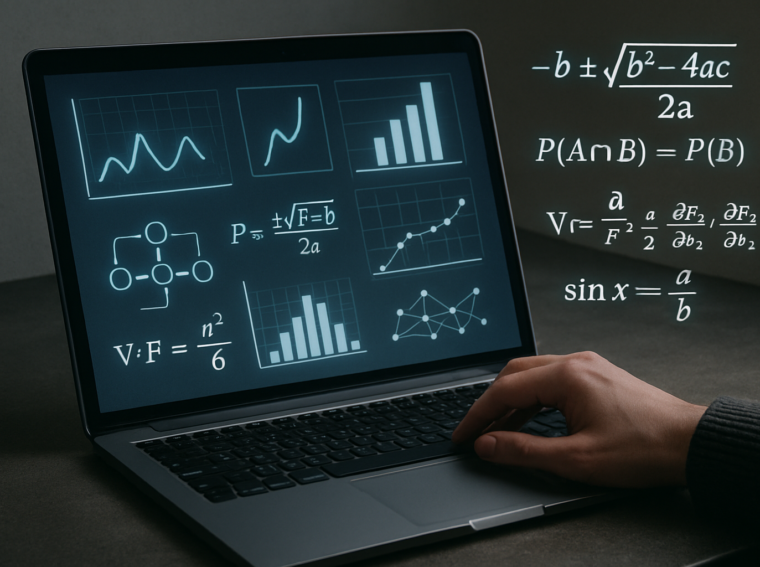
Mathematics shapes many familiar digital experiences. It supports visual effects in social apps, influences recommendation streams, guides the logic behind games, and helps platforms adapt to user behavior. These models often operate quietly in the background while improving clarity, speed, or relevance. Understanding the principles behind them gives a clearer view of how data turns into interaction.
Subtle Mechanics Behind Interactive Platforms
Modern entertainment relies on algorithms that merge statistics, probability, and geometry. These tools help systems react to input, predict outcomes, or adjust content to match personal patterns. A practical example appears in resources that focus on gameplay strategies and model behavior, where users examine risk, variance, and expected values. Early in this context, the structure of a branching path game such as Plinko offers a clear demonstration of how probability flows through multiple outcomes.
A clearer illustration emerges in an information hub that explains how branching paths behave in a setup similar to a classic peg board. Visitors find short guides, probability notes, and user observations that outline how outcomes spread across many drops. The page offers quick access to rules and data so a player can understand the structure before interacting with it. It also collects strategy notes, probability insights, and interface tips that help users interpret the system behind each result.
How Filters Build Visual Effects
Image filters in social networks run on linear algebra and signal processing. These methods transform raw pixels by applying operations to matrices that store color values.
To shape or enhance an image, the system often uses convolution kernels. These compact grids shift across the picture and calculate new pixel values using weighted sums. Sharpness, blur, contour detection, and color shifts depend on specific kernel weights.
A few core ideas help these features work:
- Matrix multiplication combines pixel groups into clearer or softer visuals.
- Fourier transforms reveal frequency patterns useful for noise reduction.
- Interpolation estimates missing values during scaling or rotation.
Each part aims to preserve structure while changing appearance. The math stays hidden, but the effect becomes immediate during use.
Why Recommendation Systems Feel Accurate
Recommendation engines rely on statistics, user modeling, and optimization. They analyze behavior signals and organize them into patterns. These predictions appear in video feeds, shopping suggestions, and news layouts.
Many services adopt hybrid systems that join collaborative filtering with content analysis. This pairing helps reduce gaps when little information is available and supports adaptation as habits shift.
Below are several common components used in these systems.
- Similarity metrics compare users or items using vectors of past behavior.
- Factorization models such as matrix factorization condense large datasets into compact latent features.
- Ranking algorithms sort items by probability of engagement, often relying on gradient‑based optimization.
- Temporal models adjust predictions when interests move over time.
The goal is not a perfect match but a steady improvement in relevance based on evidence drawn from the data.
Game Physics and Decision Models

Interactive environments use equations to simulate movement, impact, or probability. Physics engines lean on Newtonian principles to compute motion in small time steps. Collisions, acceleration, and object paths emerge from iterative updates.
Game logic also depends on probability distributions. These help designers tune rewards, estimate difficulty, or control event frequency. Randomness is not always uniform. Weighted distributions or pseudo‑random sequences ensure outcomes stay fair while avoiding predictable cycles.
To understand how these tools interact, it helps to look at the elements that guide simulation:
- State updates track every variable affecting position or timing.
- Collision detection checks intersections through bounding boxes or more complex shapes.
- Sampling methods select outcomes from distributions while keeping performance predictable.
These steps let systems run smoothly while shaping experiences that respond to user input.
Pattern Recognition in Audio and Video Streams
Streaming platforms apply mathematical models to classify content and manage quality. Compression relies on transforms that separate essential information from details the eye or ear rarely notices. In video, prediction filters compare frames and store only differences, while audio codecs remove masked frequencies based on psychoacoustic principles.
To keep playback steady, services track clarity, frame stability, and bit allocation. Adaptation systems then adjust resolution or bitrate to match the connection. The core techniques behind these steps rely on transform coding, motion prediction, and perceptual analysis, all condensed here without a list to highlight their shared purpose. Together they balance efficiency with fidelity so streams remain smooth under changing conditions.
Data Interpretation and Trust
Mathematical tools are effective only when grounded in verifiable information. Data quality, transparency measures, and model evaluation help maintain reliability.
Services routinely perform cross‑checks, measure error rates, and run controlled tests. These steps ensure predictions or visual effects behave correctly under various conditions.
Clear inspection of outcomes improves understanding of how the underlying mechanisms operate. It also strengthens trust in the systems used across entertainment platforms.
Conclusion
Entertainment technology depends on algorithms shaped by probability, geometry, and statistical modeling. These systems direct recommendations, guide user interfaces, and support graphics and audio processing. When viewed together, they form a network of mathematical tools that enhance everyday digital experiences while staying mostly behind the scenes.