
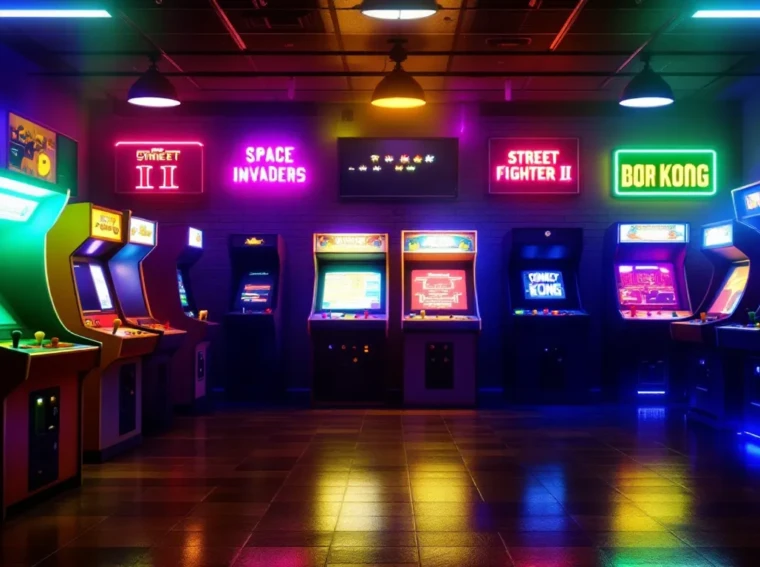
Walk into any arcade museum, and you’ll feel it immediately, that electric hum of nostalgia mixed with pure gaming DNA. The best arcade games of all time shaped not just an industry, but an entire culture. These weren’t just games: they were coin-eating machines that pulled people off the streets and into dark, neon-lit cabinets for hours on end. From the moment Pong flickered onto a screen in 1972 to the visceral impact of Mortal Kombat’s fatalities in the 90s, arcade games proved that simple premises, tight mechanics, and addictive gameplay could be more powerful than any story or cinematic sequence. This list celebrates 25 titles that earned their place in gaming history, the games that made arcades matter, the titles that still hold up today, and the classics that every gamer should experience at least once.
Key Takeaways
- The best arcade games of all time succeeded through simple premises, tight mechanics, and addictive gameplay that transcended age and background, proving that design excellence matters more than cutting-edge graphics.
- Arcade classics like Pac-Man, Donkey Kong, and Street Fighter II established design principles—clear rules, immediate feedback, and easy-to-learn gameplay—that remain timeless and continue to influence modern game development.
- These iconic arcade games created the first high-score leaderboards and competitive communities, transforming gaming into a social and competitive phenomenon that laid the groundwork for modern esports culture.
- Constraint-driven design in arcade games forced developers to focus on one core mechanic perfected rather than bloated features, a philosophy that indie developers have rediscovered and that separates legendary games from forgettable ones.
- The fairness and honesty of arcade games—applying consistent rules without manipulation, difficulty adjustment, or engagement metrics—created lasting appeal that modern live-service games often lack.
- You can experience these arcade classics today through original hardware, emulation via MAME, official console collections, or specialized arcades, making legendary arcade games more accessible than ever before.
What Made Arcade Games Cultural Phenomena
Arcade games arrived at a specific moment in history when gaming itself didn’t exist yet as a mainstream concept. Bars, bowling alleys, and shopping malls became temples for a new kind of entertainment. The magic wasn’t in graphics or story, early arcade cabinets were literally just boxes with screens and joysticks. Instead, it was accessibility and immediacy. Drop a quarter, learn the game in seconds, chase a high score in minutes. That friction-free design created something unprecedented: games that transcended age and background.
The competitive element was massive too. Arcade games invented the concept of high-score leaderboards. Your name displayed on a glowing screen made every session matter. People returned daily, sometimes weekly, to defend their rank. It wasn’t about defeating an AI, it was about proving yourself against every other player in your town. That social competitive layer turned single-player games into community events.
Cabinet design itself became cultural currency. The artwork on arcade machines was eye-catching propaganda. Kids would gather around cabinets just to watch other people play, learning strategies and absorbing the visual identity. Some arcade games had sit-down cabinets, steering wheels, or flight sticks, hardware that made you feel like you were doing something. This wasn’t just gaming: it was an experience you couldn’t replicate at home.
Classic Arcade Legends From The Golden Age (1970s-1980s)
Pong: The Game That Started It All
Technically, Pong wasn’t the first video game ever made, but it was the first one that mattered commercially. Released by Atari in 1972, it was absurdly simple: two paddles, a ball, and collision detection. That’s it. Yet that simplicity was revolutionary. Pong proved video games could work as a business. Arcades and bars ordered it by the thousands. It became a cultural touchstone so significant that for years, non-gamers assumed all video games were called “Pong.”
What made Pong stick was the two-player experience. Unlike single-player games, Pong required competition. The gameplay was instantly understandable, if you’ve ever played table tennis, you got it immediately. The novelty of digital tennis drew crowds who had no gaming experience whatsoever. Pong didn’t just start the arcade industry: it proved that video games could appeal to everyone.
Space Invaders: Birth Of The Video Game Industry
Space Invaders, released by Taito in 1978, was the moment video gaming stopped being a novelty and became a phenomenon. It didn’t invent the “shooter” genre, but it perfected the template: waves of enemies descending toward you, increasing speed and intensity, with your only defense being a weapon to move left and right. The escalating difficulty was genius, players could improve by fractions of pixels, and every session felt like a chance to beat their previous run.
The cultural impact was staggering. Concerns arose about kids wasting quarters. Newspapers ran articles about “Space Invaders addiction.” The game was so popular that arcade operators couldn’t keep machines stocked. Space Invaders created the first video game revenue boom and proved that arcade games weren’t a fad, they were the future. It also introduced the concept of patching and iteration: different arcade board versions had subtle variations that affected difficulty and scoring.
Pac-Man: The Icon That Transcended Gaming
Pac-Man, released by Namco in 1980, is arguably the most recognizable video game character of all time. The genius of Pac-Man wasn’t the character design (though that yellow dot with a mouth is instantly iconic) but the game design itself. Instead of shooting at enemies, you avoided them while collecting dots. It was a fundamentally different mechanic from the shooters dominating arcades.
The AI driving the four ghosts was sophisticated for the era. Each ghost had distinct behavior patterns, some chased aggressively, others set ambushes, and one moved randomly. Players who mastered ghost behavior could develop strategies and patterns to clear levels reliably. Pac-Man became a genuine skill-based game, not just a luck-based high-score chaser. The game’s appeal crossed demographics: it attracted players who found shooters too stressful. It was colorful, whimsical, and genuinely fun in a way that felt more playful than intense. My Abandonware offers access to classic dos games including versions of these arcade legends if you want to experience them digitally.
Donkey Kong: The Platformer That Changed Everything
Donkey Kong, released by Nintendo in 1981, created an entirely new genre: the platformer. The game featured a gorilla throwing barrels at you while you jump over them to rescue a damsel. It sounds silly now, but this was revolutionary. Instead of spaceships and invaders, Donkey Kong had personality and narrative. The story unfolded across four distinct stages, each with different hazards and mechanics.
The control precision required to jump gaps and avoid barrels established the platformer template that still exists today. Donkey Kong proved that arcade games could have character, humor, and progression beyond just surviving longer. It made Nintendo a major player in the arcade industry and eventually led to the home console revolution. The game was mechanically tight, visually charming, and addictively difficult, three qualities that define the best arcade games ever made.
Arcade Action Masterpieces That Dominated Cabinets
Galaga, Centipede, And The Shooter Revolution
Galaga, released by Namco in 1981, perfected the space shooter formula. It built on Space Invaders by adding new mechanics: enemy waves with distinct attack patterns, power-ups that appeared mid-stage, and the ability to capture your own ship and have it return to fight alongside you. That last mechanic sounds small, but it added strategic depth. Do you let enemies capture your ship for a chance to double your firepower, or play it safe?
The level design in Galaga was meticulous. Early waves are forgiving, but later stages introduce complex enemy formations that attack in coordinated swoops. Boss patterns become predictable once you understand them, rewarding pattern recognition and muscle memory. Galaga remains one of the most balanced arcade shooters ever made.
Centipede, released by Atari in 1981, took the shooter formula and twisted it. Instead of descending enemy waves, you faced a segmented centipede moving down the screen, with each segment becoming a new enemy when destroyed. The cabinet featured a trackball controller, revolutionary for arcade gaming. Using your fingers to roll a trackball felt more intuitive than a joystick for this type of precise movement.
Centipede introduced mushrooms as obstacles and hazards. These weren’t just background decorations: they blocked your movement and the centipede’s path, creating dynamic terrain. Add spiders and scorpions with unique behaviors, and Centipede became a puzzle-shooter hybrid. It proved that arcade games didn’t need to copy Space Invaders‘ formula to succeed.
Street Fighter II And The Fighting Game Boom
Street Fighter II, released by Capcom in 1991, didn’t invent fighting games, but it perfected them. Before SFII, fighting games were niche. After SFII, they were culture. The game featured eight selectable characters, each with distinct movesets and playstyles. That character variety alone was massive, players could develop preferences and mains, much like modern competitive games.
The combat system was layered. Basic attacks (punch, kick, block) were accessible, but special moves required quarter-circle or charge inputs. This created a skill floor and skill ceiling. Beginners could have fun mashing buttons: skilled players could execute frame-perfect combos and spacing-based strategies. The game received constant arcade updates introducing new characters and balance changes. Street Fighter II Champion Edition, SFII Turbo, and Super Street Fighter II were different arcade versions with substantially different meta-games.
Competitive Street Fighter II tournaments became real events. Players traveled between arcades competing for money and bragging rights. The game created the first generation of professional fighting game players. It established that arcade games could be legitimate competitive esports decades before that term existed.
Mortal Kombat: The Game That Changed Ratings Forever
Mortal Kombat, released by Midway in 1992, was violent in ways arcade games had never been. Your opponents didn’t disappear in flashes of light, they bled, died, and had their spines ripped out. The fatalities weren’t necessary mechanically, but they became the entire appeal. Kids wanted to see the fatality animations, and that desire drove arcade traffic.
The controversy around Mortal Kombat led directly to the creation of the ESRB rating system. Congressional hearings were held. Parents’ groups organized. The game was simultaneously banned in some places and protected as free speech in others. Through it all, Mortal Kombat was a genuinely solid fighting game. The character roster was diverse, the special moves were memorable, and the fatalities, while shocking, were also darkly funny.
Mortal Kombat proved that arcade games could be cultural lightning rods, not just entertainment. It proved they could generate conversation beyond the arcade community and influence broader entertainment discourse. Whether you loved or hated the game, you were aware of it.
Innovative Arcade Games That Pushed Technical Boundaries
Tempest, Asteroids, And Vector Graphics Innovation
Asteroids, released by Atari in 1979, introduced vector graphics to arcade gaming. Unlike Space Invaders‘ raster-based pixel graphics, Asteroids used straight lines and polygons drawn in real-time. This allowed smooth, rotation-based movement impossible with pixel graphics. Your spaceship rotated fluidly, creating a sense of control and precision that couldn’t exist in raster games.
The gameplay was elegantly simple: destroy asteroids before they destroy you. But the physics felt real. Asteroids tumbled at different rates: your ship had inertia and drift. Players quickly realized they could use the screen wrap-around mechanic to escape danger. Skilled players could complete entire waves without taking damage by understanding momentum and positioning.
Tempest, released by Atari in 1981, pushed vector graphics further. You controlled a ship moving around the edges of a tube viewed in perspective, with enemies emerging from the center. The visual perspective created genuine depth that blew minds in the early 80s. Tempest had rotary controls that felt amazing, smooth, responsive, and immediately satisfying.
The game difficulty ramped aggressively. Early levels were manageable: later levels introduced enemies with complex behaviors and multiple threats simultaneously. Tempest became legendary for brutality. Players spoke about reaching specific levels like they’d climbed mountains. The vector graphics combined with tight gameplay made Tempest feel genuinely modern and challenging even as arcade hardware evolved around it.
Out Run And The Arcade Racing Phenomenon
Out Run, released by Sega in 1986, was arcade racing perfected. The sit-down cabinet featured a steering wheel, pedals, and a gear shifter that made you feel like you were actually driving. The game featured branching paths, your driving decisions determined your route through iconic locations from Paris to New York. That choice element added replayability.
The visuals were gorgeous for the era. Detailed sprite work, a vast color palette, and a bright, appealing aesthetic made Out Run feel welcoming and fun rather than intimidating. Coupled with an upbeat soundtrack by Yoko Shimomura, Out Run felt like a vacation in cabinet form.
Driving physics in Out Run required genuine skill. You couldn’t just hold the accelerator: you had to brake into corners, manage your speed, and hit the apex. Crashing cost you time but didn’t end the game, so it was forgiving enough for casual players while rewarding precision from experienced drivers. Gaming websites like GameSpot would eventually cover arcade game preservation and history extensively, with Out Run consistently appearing in retrospecitive rankings.
Dragon’s Lair: Rotoscope Animation And FMV Games
Dragon’s Lair, released by Cinematronics in 1983, was a paradigm shift. Instead of traditional game graphics, it featured rotoscope animation by Don Bluth, the same animator behind The Secret of NIMH and An American Tail. The visual quality was revolutionary. The character Dirk the Daring moved with fluid, hand-drawn animation. The game looked like an animated movie you could interact with.
The gameplay was unconventional. You didn’t control movement directly: instead, you pressed buttons at specific moments to perform actions. It was essentially a timed quick-time event system decades before that term existed. You’d watch an animated sequence, react to prompts, succeed or fail based on your timing, and move to the next scene.
Dragon’s Lair sparked a wave of FMV (full-motion video) games. It proved that arcade gaming could incorporate higher-production-value content. Whether you loved or hated the gameplay, Dragon’s Lair was visually stunning and felt genuinely different from anything else in arcades. It showed that arcade innovation wasn’t just about better processors, it was about rethinking what arcade games could be.
Deep Cuts: Hidden Gems And Cult Classics
Robotron 2084, Smash TV, And High-Octane Arcade Action
Robotron 2084, released by Williams in 1982, introduced dual-joystick controls to arcade gaming. One stick controlled movement: the other controlled your firing direction. This seemingly small innovation enabled something revolutionary: movement and attack in completely independent directions. You could move left while shooting right, something no previous arcade game allowed.
The game was relentlessly intense. Waves of enemies spawned endlessly, and your only goal was survival. There was no way to “win”, just survive as long as possible while your score climbed. Robotron 2084 had a particular appeal to hardcore players who wanted pure mechanical challenge. The visuals were minimal, monochrome or two-color gameplay, but the action was overwhelming and addictive.
Smash TV, released by Williams in 1990, was Robotron 2084’s spiritual successor. It inherited the dual-joystick controls but added a game-show aesthetic. You’d fight through waves of enemies, collect power-ups, and navigate obstacle courses while a bombastic announcer hyped your performance. The cabinet featured a boom-tube design that made everything feel bigger and more explosive.
Smash TV was intentionally chaotic. Visual noise was part of the design. Projectiles, explosions, and on-screen text created overwhelming stimulus. It separated players who thrived on chaotic action from those who preferred order and rhythm. The game’s tone was absurdist and fun rather than serious, making the difficulty feel less punishing.
Sinistar And Games Ahead Of Their Time
Sinistar, released by Williams in 1982, was genuinely unsettling. The core concept: a massive glowing planet slowly descends toward you while you harvest crystals and shoot the approaching menace. If Sinistar reaches you, you die. The tension comes from time, there’s always a deadline, always an inevitable threat approaching.
The audio design was critical. Sinistar emitted an ominous rumbling that grew louder as it approached, creating genuine dread. Many players found the game emotionally intense: the constant pressure and the inevitable doom if you failed made Sinistar unique among arcade games. It wasn’t fun in a traditional sense, it was tense, and that tension was its appeal.
Sinistar proved that arcade games didn’t need to be cheerful or immediately gratifying. A well-designed pressure system and good audio could create psychological impact. The game is genuinely difficult and has an alienating aesthetic, yet it remains respected for its originality. It influenced horror game design for decades to come and remains a reference point when discussing emotional impact in gaming.
Why These Games Remain Timeless
The games on this list share fundamental design principles that transcend technical limitations. They feature clear rules, immediate feedback, and gameplay that’s easy to understand but difficult to master. There’s no tutorial in Pac-Man, yet every player knows what to do within seconds. That elegant simplicity is never easy to achieve.
These games are also mechanically pure. They’re not padded with collectibles, cosmetics, or engagement metrics. They don’t try to capture your attention through FOMO or daily quests. They’re just games, stripped to their essence. Play Donkey Kong and you’re experiencing pure platforming. Play Street Fighter II and you’re experiencing pure fighting game systems. There’s nothing else to distract you.
The constraint of arcade hardware actually enhanced design. Developers couldn’t show cinematic sequences or voice acting (usually), so they focused on mechanics. Space Invaders doesn’t need dialogue to make you feel under siege. Galaga doesn’t need storytelling to make you feel like a pilot fighting against impossible odds. The gameplay told the story.
Competitive elements built into arcade games created permanence. High-score boards and leaderboards made every session matter. You were always competing against the machine, against your previous best, or against other players. Modern single-player games often feel disposable by comparison. You beat them once and move on. Arcade games had infinite replayability because the challenge was self-imposed, improving your own performance.
Technically, these games were optimized to the point of absurdity. Every frame of animation was hand-crafted. Every pixel served a purpose. There was no room for waste because ROM space was limited and processing power was finite. This obsessive optimization created games that feel responsive, tight, and fair. When you die in Tempest, you know it’s because you made a mistake, not because the game cheated you.
That fairness is crucial. Players trusted arcade games. You understood the rules, and the rules applied equally to everyone. Modern live-service games adjust difficulty, use engagement manipulation, and prioritize session-time metrics. Arcade games just sat there, asking if you were good enough. That honesty resonates.
The Legacy Of Arcade Games In Modern Gaming
Arcade games established nearly every game genre that exists today. Space shooters came from Space Invaders. Fighting games from Street Fighter II. Platformers from Donkey Kong. Dual-joystick shooters from Robotron 2084. Every modern game designer working in those genres stands on the shoulders of arcade games.
The competitive esports scene traces its DNA directly to arcade cabinets. High-score chasers, fighting game tournaments, and speedrunning communities all have roots in arcade culture. The concepts of skill expression, competition, ranking, and community that define modern esports were invented in arcades.
Visually, arcade games influenced art direction across decades. The pixel art aesthetic that indie developers now celebrate consciously comes from arcade-era limitations. Games like Celeste, Hyper Light Drifter, and Enter the Gungeon are intentionally styled like arcade games because that aesthetic carries meaning, it evokes precision, challenge, and timeless design.
More importantly, arcade games proved something fundamental: constraints breed creativity. Developers couldn’t make anything they wanted, so they focused on making one thing perfectly. That philosophy is absent from modern AAA gaming, where bigger budgets often lead to bloated, unfocused experiences. Indie developers have rediscovered the value of constraints, and many explicitly reference arcade games as inspiration.
Arcade games also changed social gaming. They normalized competitive play in public spaces. They created communities built around shared passion rather than social networking metrics. Those communities had real stakes, your reputation at the arcade mattered. You had a rank, a playstyle, a reputation. The social structure that modern competitive gaming recreates digitally was invented in arcades with quarters and high-score boards.
How To Experience These Classics Today
Actually playing these arcade games today is easier than ever, though it depends on how purist you want to be. Dedicated arcade cabinets still exist, some arcades specialize in retro games, and there’s a thriving community maintaining and restoring original hardware. If you have the opportunity to play originals, take it. There’s nothing quite like standing in front of a cabinet that’s been dumping quarters into collectors’ pockets for four decades.
Emulation is the most accessible option. MAME (Multiple Arcade Machine Emulator) has been documenting and recreating arcade hardware for years. The emulation quality is excellent, and you can play nearly every significant arcade game ever made on a PC or dedicated cabinet setup. Games like Street Fighter II and Mortal Kombat are also available on modern consoles through official re-releases and collections.
Official compilations abound. Capcom, Williams, Namco, and other publishers have released collections of their arcade games on modern platforms. Games appear on Nintendo Switch, PlayStation, Xbox, and PC. These aren’t always perfect recreations of the arcade experience, but they’re authorized, well-maintained, and legal.
Some games have been adapted for modern systems in interesting ways. Final Fight, Castlevania, and other arcade classics have been remade or ported. Modern development tools allow these games to reach new audiences. According to Twinfinite, there are constantly updated guides and walkthroughs for playing arcade classics and understanding their mechanics if you’re coming to them for the first time.
Vintage arcade games for sale also exist through specialized retailers if you want actual hardware. Arcade cabinets still get manufactured, and collector markets thrive on original machines. It’s expensive, but building a personal arcade collection is entirely possible if you’re committed. The arcade community remains vibrant: people are actively preserving, repairing, and celebrating these machines.
For competitive players, some arcade games have active online communities. Street Fighter II tournaments still happen: speedrunning communities challenge each other on games like Pac-Man. The social aspect that made arcades special has migrated online, though something ineffable is lost when you’re not physically present competing against someone across a cabinet.
Video games have always had timeless appeal reaching back centuries, and arcade games represent a crucial evolutionary step in that history. Whether you experience them on original hardware, through emulation, or via modern ports, the fundamental appeal remains intact. These games have survived decades because they’re genuinely good. They don’t require nostalgia to appreciate, they require respect.
Conclusion
The best arcade games of all time weren’t the product of massive development budgets or cutting-edge technology. They emerged from developers solving design problems with limited resources and infinite constraint. A simple premise, tight mechanics, and infinite challenge, that formula worked in 1972 and remains effective today.
These 25 games represent different eras, genres, and approaches to arcade design, but they share a common thread: they’re fair. They don’t manipulate you into grinding or spending more money. They don’t adjust difficulty to keep you engaged. They just sit there, honest and challenging, asking if you’re skilled enough to beat them.
Arcade games are fundamentally about mastery. Every time you play, you’re measuring yourself against the machine and your previous performance. That’s why they endure. In an era of engagement mechanics and algorithmic recommendation systems, arcade games offer something refreshingly straightforward: test yourself, see if you improved, come back next time and try again.
Whether you played these classics when they first hit arcades, discovered them through emulation, or are experiencing them for the first time now, they hold up. The technology is dated, the graphics are primitive by modern standards, but the design principles are eternal. Play Pac-Man today and you’re playing the exact same game that captivated players in 1980 because the design was so good it transcends technology.
That’s what makes these games legendary. Not nostalgia, not historical importance, but the fact that they’re still fun. Decades of gaming innovation have built on their foundation, yet they remain relevant, challenging, and worth your time. The arcade golden age wasn’t just about momentary entertainment, it created an art form that’s genuinely timeless.