
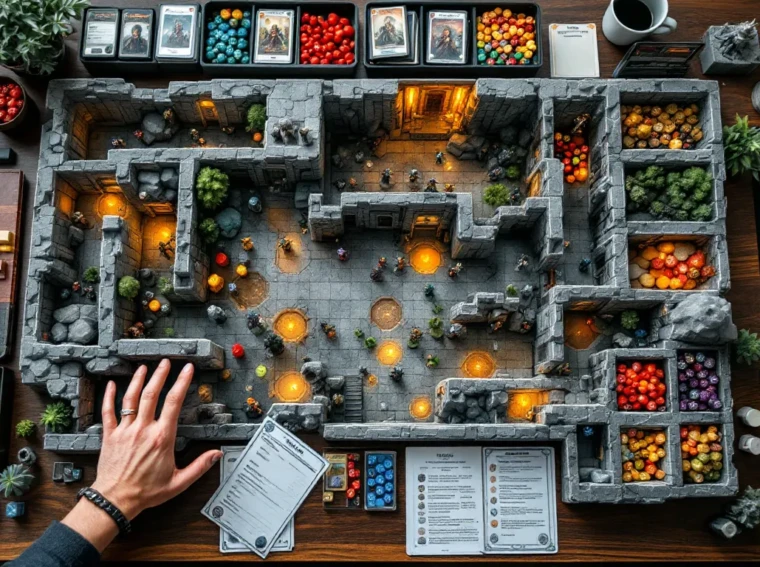
RPG board games have exploded in popularity over the past decade, transforming from niche hobby to mainstream entertainment. Whether you’re sitting down with Gloomhaven, diving into the gothic horror of Arkham Horror, or building your character in Pathfinder, these games offer something traditional board games can’t match: deep storytelling, character progression, and campaign-driven experiences that span weeks or months. If you’ve ever wanted to experience the narrative richness of tabletop RPGs like Dungeons & Dragons but prefer a self-contained, rules-light system with components you can touch, RPG board games hit that sweet spot. This guide breaks down what makes them tick, recommends 15 standout titles across difficulty levels, and shows you how to build strategies and run campaigns that’ll keep your group coming back to the table.
Key Takeaways
- RPG board games combine deep storytelling, character progression, and campaign-driven experiences that transform gameplay through player choices and persistent consequences over weeks or months.
- Character creation, leveling systems, equipment management, and branching narrative structures define RPG board games and set them apart from traditional board games that rely on simple mechanics and immediate winners.
- Beginner-friendly RPG board games like Gloomhaven and Pathfinder: Adventure Card Game ease new players in through gradual mechanics, clear winning conditions, and manageable play times under 90 minutes.
- Advanced RPG board games like Arkham Horror: The Card Game and Mage Knight reward experienced gamers with complex rule systems, deck-building, legacy mechanics, and narrative depth that unlock hundreds of hours of replayability.
- Building winning strategies requires synergistic character builds, careful resource management, team composition balance, and group coordination that turns RPG board games into cooperative storytelling experiences.
- Successfully launching your first campaign depends on matching game complexity to your group’s rules tolerance, scheduling consistency, and establishing early character investment that makes strategic decisions feel narratively meaningful.
What Defines An RPG Board Game?
An RPG board game blends the accessibility and physical components of board games with the character-driven narrative and progression systems of traditional tabletop RPGs. At their core, they give you a character, not just a token, but a detailed avatar with stats, abilities, and personal growth arcs. You roll dice not just to win a race to the finish, but to determine the outcome of dramatic moments: a critical hit in combat, a narrow escape from danger, or a crucial conversation that shifts the story.
Unlike roll-and-move games where randomness is the whole point, RPG board games use dice as a probability mechanic that fits into a larger system of strategy and storytelling. You make meaningful choices, how you spend experience points, which abilities you upgrade, what equipment you buy, and those choices cascade through the entire campaign. The board itself often transforms as you play. A town hub might expand. NPCs remember your decisions. Encounters scale to your power level.
What separates the best RPG board games from average ones is the campaign structure. Most come with rulebooks, but also story booklets that create branching narratives. Your choices in one session lock doors or open them in the next. Character deaths might be permanent. Failure states can push the story in unexpected directions rather than triggering a simple “try again.”
Key Differences Between RPG Board Games And Traditional Board Games
Narrative-Driven Gameplay
Traditional board games like Catan or Ticket to Ride have flavor text and theme, but the story isn’t the point, claiming territory or completing routes is. RPG board games invert that priority. You’re not trying to be the first to collect resources: you’re trying to survive a necromancer’s tower and the game evolves based on your performance. Gloomhaven, for example, has no winner until a campaign ends. Each scenario is a chapter in a story you collectively author. Your decisions, whether you loot a corpse or leave evidence undisturbed, affect which cards appear in future scenarios.
This narrative weight means replaying the same RPG board game is different every time. The dice roll differently. You make different choices. The story branches. Traditional games, by contrast, play out almost identically each session: the variability comes entirely from player strategy and luck.
Character Progression And Customization
In Monopoly, everyone starts with $1,500 and the same options. In Gloomhaven, your Brute might unlock a new powerful ability at level 3 while your Cragheart develops a different power tree entirely. RPG board games let characters evolve. You gain experience, unlock new abilities, find better equipment, and unlock personal questlines.
This progression matters psychologically. Newer characters feel weak. Veterans feel powerful. A 10-scenario campaign with the same starter deck feels underwhelming: a 10-scenario journey where your character gains five new abilities and custom perks feels earned. Many games, including Pathfinder: Adventure Card Game, let you carry progression across separate campaigns.
Mechanics And Rule Complexity
Traditional board games aim for elegant simplicity: learn the rules in 15 minutes, play in an hour. Ticket to Ride is a masterclass in this philosophy.
RPG board games are longer, more complex rulebooks. Gloomhaven takes 30-45 minutes to teach. Mage Knight has a learning curve that can intimidate newcomers. But this complexity isn’t bloat, it’s depth. More rules mean more decision points, more ways to interact with the world, more ways to solve problems. Combat in Gloomhaven isn’t roll-higher-than-opponent: it’s modifying your dice with ability cards, deciding card order, managing hand limits, and coordinating with allies. The complexity serves the experience.
Essential Mechanics That Make RPG Board Games Unique
Character Creation And Leveling Systems
Most RPG board games let you choose a class during setup, Rogue, Warrior, Mage, Cleric, and this choice fundamentally shapes how you play. Gloomhaven has 17+ classes (including DLC), each with unique card decks and ability progression. Pathfinder Adventures lets you pick race and class combinations that alter starting stats.
Leveling isn’t just a number going up. It’s a gate system. You can’t equip the Sword of Smiting until level 5. You don’t unlock the Whirlwind Attack until level 7. This prevents power creep and makes character building feel like unlocking a story. Some games like Gloomhaven even let you retire a high-level character to unlock a new class, creating a meta-progression ladder.
Experience gain varies wildly. Gloomhaven rewards scenarios completion based on difficulty. Pathfinder uses numbered checkpoints. Descent ties XP to enemy defeats. The progression curve shapes how the campaign feels. Fast leveling means you’ll try many builds. Slow leveling means you’ll master one character deep.
Inventory And Equipment Management
Wearing armor, collecting weapons, and managing carrying capacity adds a resource-management layer that pure board games skip. In Gloomhaven, you have limited inventory slots. That Scimitar does 2 extra damage but takes up an item slot. Do you carry it or leave it for allies? Darklight uses equipment as a deck-building system where better gear literally improves your attack cards.
Equipment doesn’t just boost stats, it changes tactics. A shield forces you to rethink your positioning. A two-handed sword locks you out of ranged weapons. Some games tie equipment to quest completion or NPC relationships, tightening the narrative. Pathfinder requires gold to buy gear, making dungeon loot meaningful.
Dice Rolling And Probability
Dice are the heartbeat of RPG mechanics. Most games use custom dice, d6s, or a mix. Gloomhaven uses modifier decks instead of dice, you draw a card instead of rolling, so probability feels tactical rather than purely random. Descent uses dice pools where more dice means better odds but isn’t guaranteed.
The RNG threshold matters. Pure roll-to-hit systems feel swingy. Probability mitigation systems, abilities that let you reroll, abilities that guarantee hits, equipment that adds automatic bonuses, let skill overcome luck. Games that let you influence rolls through card plays feel more strategic than games where dice are final.
Campaign Structure And Storytelling
A great RPG board game has a campaign arc. Gloomhaven has 95 scenarios across multiple chapters, with a persistent world that responds to your choices. Completing one scenario unlocks others. Failing one branch creates consequences.
The best campaigns have branching paths. You might face a choice: storm the castle or sneak through tunnels. Each path leads to different encounters, different loot, different story beats. By scenario 20, your campaign world looks completely different from another group’s playthrough.
Story structure varies. Some games use legacy mechanics where components get destroyed, stickers get placed, and cards get permanently removed, you can’t reset the game. Risk Legacy pioneered this. Others use book mechanics where a story guide reveals narrative beats. Arkham Horror: The Card Game uses campaign logs tracking your choices across 8-scenario story arcs.
Top RPG Board Games For Beginners
Recommended Starter Titles
1. Gloomhaven, The gold standard entry point. Scenarios take 60-90 minutes, mechanics unfold gradually, and the campaign is forgiving enough to learn through play.
2. Pathfinder: Adventure Card Game, Lighter rules, shorter play sessions (30-45 minutes), perfect for groups wanting quick dungeons without massive rulebook overhead.
3. Descent: Legends of the Dark, One player runs the dungeon as the Overlord, others play heroes. It’s storytelling meets tactical combat. Digital app guides the narrative.
4. HeroQuest, A throwback that was reprinted in 2021. Turn-based dungeon crawling, simple melee/ranged combat, fantastic miniatures. No campaign persistence but perfect for learning mechanics.
5. Talisman, Fantasy adventure game where you’re moving around a board, collecting items, gaining experience. Less tactical than others on this list but more story-focused.
6. Mice and Mystics, Lighter rules designed explicitly for teaching new players. You’re mice fighting household enemies. Campaign progresses regardless of wins/losses.
7. Zombicide, Cooperative zombie slaying. Super straightforward: kill zombies, level up, find loot. Fast rounds, satisfying progression, minimal downtime.
Why These Games Ease New Players In
Beginners need clear learning curves. Gloomhaven teaches one new mechanic every scenario. By scenario 5, you understand the full system. Descent: Legends of the Dark has a companion app that is the Overlord, eliminating complicated AI rules one of the most annoying barriers to entry.
Play time matters. New groups shouldn’t commit 3+ hours to their first session. Pathfinder Adventure Card Game finishes in under an hour. Mice and Mystics runs 30-45 minutes. You’re not exhausted by rulebook overhead before you grasp the fun.
Winning condition clarity is crucial. Beginners get frustrated if they don’t understand what success looks like. Zombicide: kill the zombies. Gloomhaven: complete the objective on your scenario card. No ambiguity. Games with emergent storytelling or subtle win conditions frustrate new players: save those for experienced groups.
Advanced RPG Board Games For Experienced Gamers
Complex Mechanics And Deep Storytelling
Once you’ve run 50 scenarios of Gloomhaven, you’re ready for the deep end. Mage Knight is infamous for its density: modular map building, spell combos, combat resolution that rewards optimization, and solo/cooperative/competitive modes that all feel distinct. A single scenario is a puzzle box.
Arkham Horror: The Card Game layers deck-building onto narrative structure. You deck-build between scenarios, incorporating clues and resources you found. Your deck becomes your character. Failure doesn’t just mean you retry: it means you’re traumas and sanity damage carry forward. Some investigators can suffer permanent damage that locks out builds.
Frosthaven, the Gloomhaven sequel, assumes you understand the base game and adds city construction, item crafting, prosperity tracking, and faster combat resolution. It’s Gloomhaven compressed and expanded simultaneously.
Sleeping Gods is a legacy game that destroys cards and places permanent stickers. Once you finish the campaign (20-30 sessions), the game is altered forever. Your choices permanently shape the game world. It’s a narrative experience more than a strategy game.
Community Favorites And Hidden Gems
Robinson Crusoe: Adventures on the Cursed Island is criminally under-discussed. It’s cooperative survival where every turn drains resources: food, tools, sanity. You’re managing scarcity, making impossible choices, and the game can spiral into unwinnable states fast. Deep, punishing, rewarding.
Black Plague and Massive Darkness are Kickstarter darlings that deliver dungeon crawling with insane miniature counts and modular dungeon building. The campaign mechanics feel thin compared to Gloomhaven, but the combat crunch and loot drops feel juicy.
The 7th Continent is a wild-card: a puzzle-adventure game where you’re exploring an island, uncovering mysteries through card draws and symbol matching. No combat. All exploration and deduction. Runs 10-15 hours per playthrough.
Too Many Bones deserves a shout. It’s a dice-crafting game where you collect dice as loot, and those dice become your abilities. Character customization is absurd, hundreds of possible builds. Play sessions are meaty but rewarding. Resources from sources like RPG Site frequently rank it among the most replayable options available.
How To Build A Winning Strategy In RPG Board Games
Character Build Optimization
Building synergy is the difference between adequate and dominant. In Gloomhaven, don’t just level random abilities. Read your deck. The Brute has passive perks that trigger when you attack with melee weapons. A winning build stacks those: pick items that boost melee damage, spend card plays that modify attack rolls, take perks that support close-range combat. Your level 5 Brute won’t feel powerful if you grabbed a ranged attack card and some defensive abilities. You’ve diluted your effectiveness.
Check ability scalings. Some classes scale linearly, more intelligence equals better spells. Others have exponential breakpoints. The Spellweaver gets massive returns from +1 to spell power because spells hit multiple targets. Three spell power is better than one.
Team composition beats individual optimization. A party of four Rogues will struggle. Rogues don’t heal. Rogues don’t tank. A balanced roster, tank, healer, damage dealer, utility, adapts to unknown scenarios. You can’t scout ahead in Gloomhaven, so overspecialization leads to brutal losses on unfamiliar encounters.
Resource Management Tips
Gold isn’t infinite. In many games, you’ll face the choice: enhance your weapon or buy armor? Long campaigns punish greed. A common mistake is hoarding gold waiting for the perfect purchase. By the time you have 200 gold, the game’s halfway done and you’ve taken unnecessary damage with weaker gear.
Set spending budgets by scenario count. If you know there are 40 scenarios, rough math: by scenario 20, you should own most gear you need. By scenario 30, you’re consolidating into your final builds. Don’t save your entire treasury for “that one epic item.” Marginal gains matter, a +1 armor piece buys you health now.
Item slots are scarcer than gold. In Gloomhaven, you might have 300 gold but no inventory space. That Helm of Courage costs 30 gold but takes a slot. Is the +1 to attack better than your secondary armor? Maybe, maybe not. Some RPG board games force genuine itemization pressure.
Cooperative Vs. Competitive Gameplay Tactics
Cooperative games demand communication but reward group optimization. In Gloomhaven, you must discuss your moves before committing cards. “I’m playing Dash + attack. That’ll clear those enemies. You sweep left?” Coordination beats individual brilliance. Games punish silence.
Competitive games punish telegraphing. Never announce your full strategy beforehand. A subtle misdirection, spending gold on one item while planning to buy another, creates advantage. Some experienced gamers in PvP modes read opponents like poker players: scanning for tells, exploiting patterns.
Asymmetric games (where players have different roles/powers) need careful communication vs. secrecy balancing. Descent: Legends of the Dark makes the Overlord win if any hero dies, so heroes must coordinate. But the Overlord doesn’t share their strategy, so unexpected encounters happen. This tension creates drama.
Setting Up Your First Campaign: A Step-By-Step Guide
Choosing The Right Game For Your Group
Start by asking: how often can you meet? Gloomhaven demands consistency. Scenarios sprawl 60-90 minutes and campaigns span 40+ sessions. Committing to a monthly meetup means the campaign takes 3+ years. That’s a fantastic problem to have, but groups dissolve. Pick games that can wrap in 8-12 sessions for reliability.
How much rules overhead can your group tolerate? Introduce Mage Knight to a “beer and pretzels” crowd, and you’ll watch eyes glaze. Introduce Zombicide to power gamers, and they’ll finish campaigns bored. Match complexity to your audience.
What’s your narrative appetite? Some groups are all-in on roleplay, character backstories, and voice acting. Others just want monsters and loot. Arkham Horror feeds the narrative crowd. Zombicide feeds the action crowd. This isn’t a judgment call: it’s a logistics problem. Mismatched expectations kill campaigns.
Research setup time before you buy. Gloomhaven takes 10-15 minutes to set up each scenario. Descent takes longer because you’re building the dungeon. Too Many Bones requires significant dice organization. If you’re squeezing in gaming between work, a 15-minute setup is a dealbreaker.
Essential Materials And Setup Requirements
You’ll need a table large enough for components, dice, character sheets, and player movement. Gloomhaven sprawls considerably, board plus four character mats plus loot piles plus enemy tokens. Ideally, you’re looking at a 4×4 foot minimum.
Organization systems save your sanity. Plano boxes, foam inserts, card sleeves, invest in these upfront. Searching through a pile of tokens for “which one is the Spellweaver” for five minutes kills pacing.
Read the rulebook before session one. Seriously. Stopping mid-scenario to look up a ruling kills momentum. Watch a tutorial video (YouTube creators like Pocket Tactics break down rulesets brilliantly) and do a solo run if possible. Your first campaign session will have questions, but you’re not learning how to play: you’re learning strategy.
Print errata sheets. Most games get updates post-release. Check the publisher’s website for clarifications, balance patches, or rule changes. Running outdated rules ruins experienced players’ fun.
Creating An Engaging Gaming Session
Set the mood. Music helps. Ambient playlists on Spotify transform game night from a rules slog into an experience. Lighting matters too. Dim the lights for horror games. Keep them bright for dungeon crawls. This isn’t pretension: it’s environmental storytelling that costs nothing.
Establish character buy-in early. In character creation, let players describe their adventurer. What’s their goal? Why are they in this dungeon? These aren’t mechanics, but they’re why players care about that character’s survival. A character with a story arc gets protected: a blank token gets yolo’d into danger.
Pace scenario length appropriately. New groups move slower. Plan to start simple. Gloomhaven lets you choose difficulty: pick “easy” for your first few scenarios. You’ll still win, but barely. Winning early scenarios builds confidence. Steamrolling unfun.
Create continuity between sessions. Keep a campaign journal. Before each session, recap what happened last time and remind people of unresolved plot threads. “Last week, the innkeeper warned you about bandits on the north road. You’re heading there now. The tension from that warning carries forward.”
Celebrate character achievements. When someone completes a personal quest or makes a clutch save, acknowledge it. Celebrate it. These moments are why RPG board games beat pure strategy games. The emergent storytelling from randomness and choice is the actual product you’re selling.
Conclusion
RPG board games occupy a unique space in gaming. They’re accessible enough for newcomers, complex enough to engage veterans, and narratively rewarding in ways that pure strategy games aren’t. Whether you’re drawn to the class-based optimization of Gloomhaven, the investigation tension of Arkham Horror, or the pure combat crunch of Zombicide, there’s a title that fits your table.
The key is starting with honest self-assessment. Know your group’s patience for rules, their availability for long campaigns, and their narrative appetite. Pick a game that matches those parameters, run your first campaign properly prepped, and commit to at least 3-5 sessions before deciding. Most groups get more than enough value to justify buying the game after that.
Once you’re deep into a campaign and your characters have leveled up, equipment has evolved, and choices from earlier sessions are cascading into new consequences, you’ll understand why RPG board games have become a phenomenon. They deliver stories that feel yours in a way that novels, video games, or traditional board games rarely match. That’s not just entertainment: that’s why gaming is worth your time.