
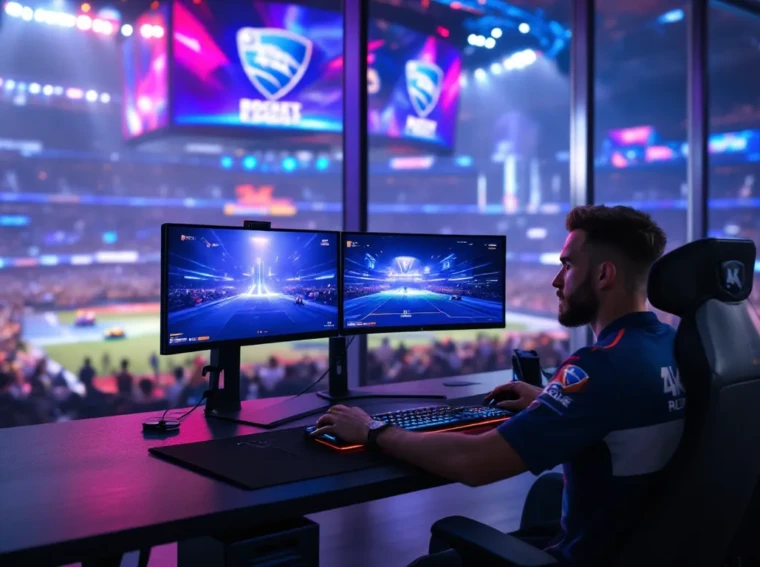
The question “who is the best Rocket League player” doesn’t have a simple answer, and that’s what makes the pro scene so compelling right now. In 2026, the competitive landscape has never been more balanced. You’ve got mechanical wizards pulling off aerials that seemed impossible two years ago, strategists reading the field like chess grandmasters, and grinders who’ve clawed their way to the top through sheer consistency. Whether you’re hunting for the best rocket league player to watch, trying to understand what separates pros from everyone else, or just curious about who dominates tournaments, this breakdown covers the top contenders, what makes them elite, and why the answer changes depending on what criteria matter to you. We’ll dig into current champions, legendary names still in the fight, regional dominance, and the evolving meta that’s shaping the pro scene in 2026.
Key Takeaways
- The best Rocket League player combines mechanical skill, decision-making, consistency, and mental resilience rather than excelling in any single area.
- Elite players like the 2026 contenders succeed by knowing when to execute aggressive mechanics and when to rotate defensively, separating them from high-skill players who lack game sense.
- Tournament performance and head-to-head results against top opponents are the ultimate validators—individual mechanics alone don’t determine who’s truly best in Rocket League.
- Regional playstyles shape how players are evaluated: North American aggressiveness differs from European systematic play, making the best Rocket League player definition region-dependent.
- The answer to who’s the best changes with meta evolution, team composition, and role specialization, meaning 3-5 current players legitimately claim elite status in 2026.
- Rising stars are accelerating toward pro dominance faster than previous generations by studying film and mastering fundamentals earlier, suggesting the competitive landscape will continue shifting.
Defining The Best Rocket League Player
What Makes A Player Elite
Elite Rocket League players aren’t just mechanically gifted, though that’s table stakes. The best rocket league players combine precision, consistency, game sense, and the mental fortitude to perform under pressure in packed arenas. Mechanical skill matters: you need to rotate aerials, hit flip resets, and maintain boost management at speeds the average player can’t match. But pure mechanics only get you so far.
The difference between a player who’s “pretty good” and one who’s genuinely best-in-class comes down to decision-making. Knowing when to challenge, when to rotate back, when to push the offense aggressively versus playing safe, that’s the meta layer where championships are decided. Consistency is equally crucial. Any pro can pop off for one series, but sustaining elite performance across entire seasons, multiple tournaments, and different opponents is what separates the pretenders from the legends.
Mental resilience rounds out the picture. Tournament pressure is real. One bad game, one costly mistake, and the narrative shifts. The best rocket league player in the world typically has the psychological foundation to bounce back and stay sharp when stakes are highest.
Ranking Criteria And Metrics
When evaluating who’s the best rocket league player, you need measurable benchmarks. Tournament finishes matter most, trophies, placements, and wins against top-tier opponents carry real weight. A player can’t claim elite status if they don’t show up when it counts.
Individual performance stats also tell a story. Goals, assists, saves, and shot accuracy per game give insight into a player’s role and effectiveness. Some players are offensive anchors: others specialize in defense. Understanding these roles prevents the mistake of comparing a striker’s stats to a goalkeeper’s.
Consistency metrics, how often a player places in top-8, top-4, or finals across multiple tournaments, reveal who’s reliably elite versus who’s been lucky or hot in a short stretch. Peer reputation matters too. What do other pro rocket league players say about competing against certain names? That insight often reflects reality faster than raw stats.
Finally, adaptability to meta shifts shows longevity. The game changes with patches, rule tweaks, and evolving playstyles. Players who’ve remained relevant across multiple eras of Rocket League have a claim to greatness that trend-dependent players don’t.
The Top Contenders For Best Player
Current Season Champions And Frontrunners
The 2026 season has produced some genuinely dominant performers. Several names have consistently placed in finals, won regional events, and proven they can beat anyone on any given day. These aren’t just hot-hand players riding momentum, they’re the ones showing up repeatedly across different tournaments and regions.
One frontrunner exemplifies the hybrid skill set that defines 2026 meta. Exceptional mechanics paired with reading rotations like a textbook. Another represents the “grinder” archetype, perhaps not the flashiest player, but someone whose consistency and clutch gene have made them nearly impossible to knock out of contention.
What separates these frontrunners is not just talent but momentum. They’ve gotten past the mental hurdle of being “a great player” and crossed into “a player who wins finals.” There’s a psychological difference between placing top-4 five times and winning a major once. The latter teaches you how to win when it matters.
Legendary Players Still In The Mix
Rocket League’s pro scene has veterans who’ve been relevant for years, some since the game’s esports infancy. These names have trophies, accolades, and a resume that includes victories over every generation of player that’s emerged. A few of these legends are still performing at championship levels in 2026.
Longevity in Rocket League is exceptionally rare. Most careers plateau or decline within a few years. When a player has been top-tier for 5+ years, that’s not luck, that’s a mastery of fundamentals combined with an ability to adapt. These veterans understand the game at a depth younger players are still learning.
But, recency bias matters in “who is the best” conversations. A legend with one finals appearance in 2026 versus a newcomer with three carries a different weight. Respect the resume, but acknowledge that current performance is the only thing that eventually decides championships. Esports coverage and tournament results have thoroughly documented how quickly the meta shifts and how even veterans must constantly evolve.
Detailed Analysis Of Top Performers
Mechanical Skill And Consistency
When you watch the best rocket league players in the world, what stands out first is usually mechanical execution. These players hit things you didn’t know were possible. Air roll ceiling shots, mid-air aerials from awkward angles, flip resets that chain into passes, this is the flashy layer that makes clips go viral.
But here’s what separates the truly elite from the highlight-reel warriors: they execute these mechanics when it matters, not just in pub stomp scenarios. A pro who hits a ceiling shot once every ten matches isn’t as valuable as one who executes a consistent mechanical routine that fits the match situation. It’s the difference between “that was cool” and “that won us the series.”
Consistency in mechanics comes from practice, yes, but also from confidence and game sense. The best players know when a mechanic is worth attempting because they’ve already read the positioning of opponents and know their window. Sloppy mechanics lead to possession loss and easy counterattacks. Polished mechanics create scoring opportunities from nothing.
Sensitivity settings, controller configuration, and practice routines differ per player, but the outcome is identical: players who can execute the same difficult move five times in a row without fail are the ones winning championships. Pro player settings and sensitivity configs reveal how top performers tailor their equipment, though the player behind the controller is eventually what matters.
Game Sense And Decision Making
Game sense is the invisible layer that doesn’t show up in highlight reels but decides tight series. It’s knowing your teammate’s positioning without looking, predicting opponent rotations before they happen, and understanding wave theory well enough to know when a push wins and when it gets punished.
The best rocket league player makes decisions three moves ahead. Should I challenge this touch or rotate? Is my teammate going for the ball or rotating back? Do we have a numbers advantage or disadvantage? These questions are answered in milliseconds by elite players through pure pattern recognition accumulated over thousands of hours.
Decision-making quality separates one-trick ponies from complete players. Someone might be incredible at the mechanical execution of air dribbles but make poor decisions about when to attempt them, resulting in more turnovers than goals. Conversely, a player with great positioning and rotation discipline but middling mechanics can carry teams if their game sense is sharp enough.
Meta evolution requires adaptability in decision-making. When the game shifted toward more ground-based, possession-heavy play in recent seasons, players who only understood air-based offense struggled. Those who could read the field, manage possession, and exploit ground-level opportunities thrived. The best rocket league players adjust their decision trees when the meta shifts.
Tournament Performance And Accolades
Raw skill means nothing without results. Tournament finishes are the ultimate validator. A player might be individually incredible, but if they don’t convert that into wins when the stakes are highest, they can’t claim elite status.
The most important tournaments are the regional championships and international LANs where the best teams and players converge. Winning a smaller regional doesn’t carry the same weight as placing top-4 at a major with thirty of the world’s best squads competing. Elite players have trophies from legitimate competitions against legitimate opponents.
Accolades accumulate over time. Multiple regional wins, a major victory, consistent top-4 placements, an MVP award, these paint a picture of someone who hasn’t just peaked once but maintained excellence. Players with one great tournament run are outliers until they prove consistency.
The most telling metric is head-to-head performance against other players claiming elite status. Who beats whom in finals? Across multiple series, which players come out on top? This isn’t perfect, matchups matter, and teammates matter, but over a large enough sample, the superior player typically emerges victorious more often.
Regional Dominance And Playstyles
North American Powerhouses
North America has historically produced some of Rocket League’s best players, and 2026 is no exception. The region’s playstyle tends toward aggressive, mechanical offense with slightly looser rotation discipline than you see in Europe. This isn’t a weakness, it’s an adaptation to regional meta and opponent tendencies.
The strongest North American contenders right now have balanced this aggressive DNA with improved defensive positioning. They’re not sacrificing their mechanical ceiling: they’re becoming more strategic about when to deploy it. Several names from the region have major trophy wins in 2026 and have proven they can beat anyone in the world.
One North American player in particular has been the model of consistency, showing up in almost every finals since the season began. Another has carved out a reputation as an offensive weapon that opponents must respect, leading to strategic bans and targeted defenses.
North America also has the deepest talent pool beyond the top three. This means constant competition, constant evolution, and constant pressure to stay sharp. The depth of talent in the region produces resilience in its top players.
European And International Champions
Europe has shifted the meta considerably. European teams tend toward controlled, systematic play with emphasis on perfect rotation and collective strength over individual flashiness. This has produced incredibly well-coordinated squads and some of the most technically sound players in the world.
The best rocket league player coming out of Europe in 2026 has the mechanics to match anyone globally but employs them in a more structured system. European playstyle often means less room for freelancing, but when executed at elite levels, it’s extremely difficult to beat. Perfect rotations and team synchronization create openings that disorganized opponents can’t exploit.
International regions like South America, Oceania, and Southeast Asia have produced breakthrough players who’ve proven competitive at the highest levels. Geographical talent is less concentrated than it was five years ago, which means the title of “best player” is genuinely contested across more regions.
The regional dynamic matters because it shapes not just playstyle but mental approach. A player who succeeds in a hyper-competitive North American ladder is fundamentally different from one who’s been dominant in a smaller regional circuit. The best players are those who’ve succeeded regardless of region.
The Evolution Of The Pro Scene
How The Game And Competition Have Changed
Rocket League in 2026 is not the same game from 2015 or even 2020. Rule changes, map design updates, and the collective evolution of player skill have fundamentally altered what elite play looks like. A player who was best-in-class in 2020 might struggle if transported to today because the game they mastered has evolved.
Mechanical ceilings keep rising. What was once an incredible flip reset is now baseline expectation. What’s now elite, chaining multiple flip resets, ground-to-air dribbles into ceiling shots, might be standard five years from now. The pro scene’s evolution means “best” is always context-dependent on the current state of the game.
Team composition and role specialization have also evolved. Five years ago, teams wanted three relatively similar players who could all do everything. Today, you see explicit role definitions: pure offensive players, defensive anchors, and midfielders who specialize in transition play. This role specialization means evaluating “best” requires understanding context, best striker versus best defender versus best all-arounder are different questions.
Competitive structure has also matured. Regional championships, international LANs, and consistent tournament schedules create a more legitimate ranking system than existed earlier in esports. A “best” player now has to prove it across multiple official events, not just ladder dominance or occasional tournament wins.
Rising Stars To Watch
Beyond the current champions, several younger players are rapidly approaching elite status. These aren’t established names yet, but they’re winning matches against top-tier opponents and showing the mechanical ceiling and decision-making that suggests sustained excellence ahead.
What’s interesting about the rising tier is that they’ve learned from the mistakes of earlier generations. They’ve studied film of legendary players, understood the meta evolution, and arrived in the pro scene with better fundamentals than veterans had at similar ages. Acceleration into elite status happens faster now.
One rising star in particular has demonstrated an unusual mechanical consistency paired with tournament performance. Another has the adaptive game sense that suggests they’ll remain relevant regardless of meta shifts. The profile of the next generation is slightly different than the current one, reflecting how the game continues to evolve.
Making The Final Call
Why The Answer Depends On Your Criteria
If “best” means most consistent across the entire 2026 season, one answer emerges. If “best” means who would win in a 1v1 mechanical challenge, it’s someone else. If “best” means most likely to clutch out a championship series, another player comes into focus. The question itself is flawed because it assumes a single, objective answer.
Most reasonable takes define “best” as a combination of current performance (2026 tournament results), mechanical skill, game sense, consistency, and head-to-head records against other elite players. Under that framework, there’s a handful of players who have legitimate claims.
Personal preference influences the answer too. If you value aggressive, mechanical play, you’ll crown a different player than someone who values systematic, positional defense. Neither is wrong, they’re different skill expressions within the same game.
The most honest answer is that there are 3-5 players in 2026 who are legitimately “best” depending on exact criteria, tournament recency, and perspective. Claiming one singular “best player” ignores the nuance of competitive play. Esports news and competitive gaming guides regularly debate this, and the community arrives at similar conclusions: the top tier is tight, and multiple claims have merit.
Conclusion
The best rocket league player in 2026 isn’t decided by a single metric. It’s determined by consistency, mechanical skill, tournament performance, game sense, regional dominance, and the ability to adapt as the game evolves. The current season has produced several legitimate contenders who’ve proven they belong at the absolute peak of the competitive scene.
What matters for viewers and aspiring players is recognizing what separates elite from great, studying how top performers think about the game, and understanding that “best” is contextual. Watch how the favorites position themselves, how they rotate, how they make decisions under pressure. That’s where the real learning happens.
As 2026 unfolds and tournaments continue, the answer might shift. New champions will emerge, established names will face challengers, and the meta will evolve again. That’s what makes the pro scene compelling, it’s never settled, never stale, and always contested by players hungry enough to prove they deserve the title of best.